
You reach for the faucet on an ordinary morning, and the handle sticks a quarter-turn before it gives. The bath mat is damp again at the same spot near the tub, even though nobody splashed. The vanity drawer still doesn't close all the way since the humidity swelled it last winter. None of these things stop you from getting ready. That's exactly why they pile up for years before anyone treats them as a pattern instead of a list of small annoyances.
A bathroom doesn't fail all at once. It sends a string of individual, easy-to-explain-away signals, and each one on its own looks minor. Read together, they tell you what you're really dealing with: a fixture swap, a repair, or a room that has quietly reached the end of its usable life.
Water Reaching Past Where It's Supposed to Stop
Every wet surface in a bathroom depends on a seal doing its job: caulk at the tub and shower joints, grout holding tile in a waterproof plane, and a shower pan or tub liner underneath it all. Those seals are consumable. Caulk skins over, shrinks, and eventually pulls away from the surfaces it was bridging, and once there's a gap, water finds it on every single shower rather than most of them.
What matters for a remodel decision isn't whether you've ever seen a stain or a soft spot; that's its own read on a different problem. What matters here is whether the seals themselves are failing as a system: caulk lines that keep separating within months of being redone, a shower pan that never fully dried between uses, or a floor near the tub or toilet base that gives slightly underfoot. Re-caulking a joint buys a season. A substrate that has been absorbing water for years under a repeatedly failing seal is a different scope of work, and it's usually bigger than the surface crack that got your attention.
Press along the base of the tub or shower wall with your palm. A section that flexes, or that sounds hollow compared to the tile beside it, points to a compromised substrate rather than a surface fix.
Fixtures and Finishes Wearing Out Ahead of Schedule
A faucet, valve, or toilet has a rated service life, and most fixtures are built for many years of daily use before their internal parts wear past easy repair. Where the water feeding a house carries a heavy mineral load, that mineral content deposits inside aerators, showerhead nozzles, valve cartridges, and the tank and heating element of the water heater supplying the room. The same chalky crust that shows up on the outside of a spout is also building up inside the mechanism, and a stiff valve or a trickling spout in that house may be scale rather than wear. Where the supply water carries little dissolved mineral content, the same fixtures don't build that internal scale, and a fixture problem there is more likely a worn cartridge or seal doing exactly what age does to any moving part.
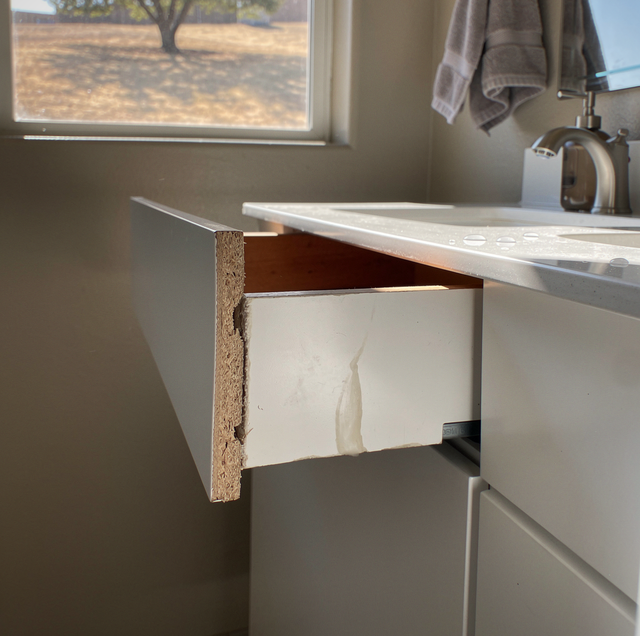
Finishes age on a separate track from fixtures. A fiberglass or acrylic tub surface develops a network of fine surface cracks once its factory coating has taken enough years of cleaning chemicals and temperature swings; a cast-iron or steel tub loses its enamel in patches instead, exposing the base metal underneath. A vanity countertop with a laminate edge that has delaminated at the sink cutout, or cabinet doors with swollen particleboard at the bottom corners, are both signs the materials themselves have absorbed more moisture than they were built to handle over their working life.
Not every dated finish means a material is failing. A color scheme, tile pattern, or fixture style can look out of step with the rest of the house well before anything underneath it actually wears out, and that's a separate signal from the ones above: a cosmetic mismatch rather than a functional one. The distinction matters for scope, because swapping a finish that still functions is a different project than replacing one that's failed.
A Layout That Fought You Before You Ever Moved In
Some remodel signals have nothing to do with anything breaking. A single sink in a bathroom two adults share every morning, a door that swings into the only clear floor space, a shower stall too narrow to turn around in comfortably, or storage that ran out years ago and got replaced by a shelf balanced on the toilet tank: these are functional mismatches, not failures. The room does what it was built to do; it just wasn't built for how the household actually uses it now.
Age plays into this too. Bathrooms built decades ago were often sized and wired for a household with different expectations: a single light fixture over the mirror instead of task lighting at the vanity, or a tub-shower combo in a house where someone now needs a curbless entry to use it safely. None of that is dangerous by itself, and none of it requires touching anything today. It becomes relevant the moment you're weighing whether to patch the room again or rebuild it to fit how it's being used.
A bathroom outlet that trips repeatedly, or that no GFCI outlet or breaker protects, is a shock hazard next to water. Stop using it and have an electrician trace the circuit; do not open the box yourself.
Small Signs That Add Up Faster Than They Look
Individually, a slow drain that a plunger only half-fixes, a toilet that rocks slightly when you shift your weight on it, and exhaust that leaves the mirror fogged longer than it used to can each be waved off as a one-item fix. Stacked together in the same room within the same year or two, they describe a bathroom whose systems are aging in parallel rather than one part failing in isolation. A light switch that has started to feel warm is different: that's a heat warning, not a remodel signal, and it calls for an electrician to check it now rather than a spot on this list.
That distinction matters because the systems inside a bathroom wall share space. Supply lines, a drain stack, ventilation ducting, and circuit wiring for lights and outlets all run through the same narrow cavity behind the tile. Once wall or floor surfaces come off for one repair, every other system sharing that space becomes visible and correctable at the same time, well before the next item on the list would otherwise force a second opening a year later.
What a Contractor Opens First to Confirm Scope
When several of these signs show up together, the scope settles on the wet wall behind the tub or shower, where seals, framing, and rough plumbing all meet in the smallest footprint. A contractor reads it first from the outside: moisture readings, a floor that flexes underfoot, an access panel if the house has one. Demolition then confirms it by opening that same wall. What turns up there answers three questions before anything gets ordered: whether the framing and subfloor underneath are sound enough to build on, whether the supply and drain lines are in good enough shape to leave in place or need rerouting, and whether the circuit serving the room meets current safety expectations. What's found behind that one section splits a repair estimate from a remodel estimate, because it decides whether the rest of the room needs to come apart too or can stay closed up.
Frequently Asked Questions
A gut remodel that keeps the layout the same runs on a schedule of weeks rather than days, set by demolition, rough-in inspection, tile cure times, and fixture lead times. Changing the floor plan itself adds time to that base schedule.
The factory edge on a laminate counter is sealed at the plant, but the cutout for the sink is cut on-site and usually receives only a bead of sealant at that seam. Every hand-washing splash lands right at that cut edge, and once the sealant there wears through, the exposed particleboard substrate underneath soaks up water and swells long before the rest of the counter shows any sign of moisture damage.
Yes. A toilet bolted correctly to a solid floor doesn't rock. Movement usually means the wax ring sealing the toilet to the drain flange has broken its seal, which lets both water and sewer gas escape underneath with every flush, or it means the subfloor itself has softened under the base and is no longer providing a rigid surface for the fixture to sit on.
It changes what gets opened up, not just how long the work takes. Keeping fixtures in their existing locations means the drain stack and supply lines remain where they are, so only walls and floors need to be opened where finishes are being replaced. Moving a toilet, tub, or sink to a new wall means opening additional floor and wall space to reroute the lines.
Cosmetic items like a vanity, mirror, or light fixtures can be swapped on their own. Anything behind the wall is the part worth doing in one pass: on a permitted job, it is inspected at rough-in, before the walls close, and finishing the room first and moving a line later means tearing out new tile to get back to it.
A cast-iron tub is a rigid shell that's typically set in before the surrounding walls are finished, so removing it means opening up more than the tub itself; its shell rarely fails, so a new surface coat restores it at far less cost in demolition. A fiberglass or acrylic tub can be refinished too, but its lighter shell comes out of the alcove easily, and once that shell itself has flexed or cracked through underfoot rather than just lost its finish, a new coating won't fix what's happening structurally underneath it, so replacement is the more common call there.
Get a bathroom scope walkthrough — find out whether these signs point to a repair or a full remodel. Clover Valley Home Service serves Greater Sacramento, Placer, and El Dorado counties. CSLB #1003154. Call (916) 742-3141.