
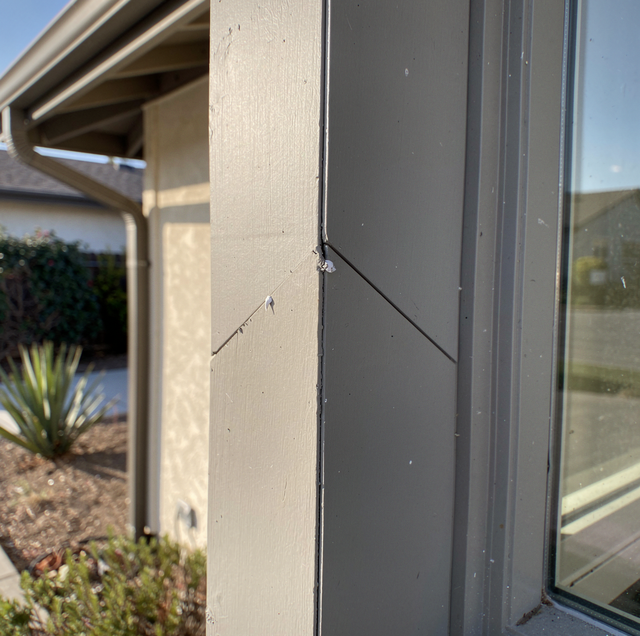
Painted wood trim can look tight and freshly finished, while the wood beneath the paint has already gone soft. Paint on the face of a board does its job: it sheds rain that hits it head-on and slows how quickly the surface loses or gains moisture. But paint protects only the surfaces it coats evenly, and water finds the places it doesn't. At a cut end, an open joint, or a fastener hole, water gets past the paint film and soaks into the core of the board. Once it's inside, the same paint film that kept rain off the face now works against you: it slows the wood from drying back out between wettings. Fungus needs sustained moisture to establish itself, and that trapped water provides exactly the conditions it requires, working inside a shell of paint that still looks like new. That's why trim can pass a glance, and even a light touch on the face, while the wood behind it has already lost its structure.
Each entry point on a painted board lets water through a finish that otherwise looks intact, and each leaves its own early mark on the paint before the wood underneath gives way:
| Entry point | How water gets in | What shows on the paint first |
|---|---|---|
| Cut ends and end grain at miters and butt joints | Open wood fibers pull water in along the grain instead of across it | A dark line right at the miter or joint |
| Open or failed caulk at a joint | The seal has split or pulled away from one side | A hairline crack tracing the joint |
| Nail and screw holes | Water works into the hole around the fastener shank | A small blister or a ring lifting around the fastener head |
| The unpainted back face against siding or sheathing | Left bare at install, it takes on water; the front sheds | Paint that dents under a thumb while the face still looks fine |
| Trim bottoms on a roof, a deck, a step, or near the ground | The bottom edge sits in contact with a surface that stays damp | Paint failing low on the board while the top stays sound |
| Horizontal ledges and sills that hold standing water | A flat top surface holds rain instead of shedding it | Paint blistering along the flat surface |
| Fascia behind a gutter | Water spilling or backing up behind the gutter reaches the wood behind it | A blister or dark staining trailing below the gutter |
Why Cut Ends and End Grain Drink Water
Wood fibers run the length of a board as long, hollow cells. A cut face, at a miter or a butt joint, opens the ends of those fibers directly to whatever touches them. Water reaching a cut end travels along the grain rather than across it, entering the wood through open channels rather than seeping slowly through the tight face grain of a flat, painted surface. That's why a cut end can be taking on water at a joint long before the same amount of water sitting on the painted face would ever get through it. A miter is two cut ends meeting at an angle, which means the board's weakest surface is pressed directly against another board's weakest surface, with only a bead of caulk and a coat of paint standing between that end grain and the weather.
Failed Caulk and Joints That Open
Caulk bridges the gap between two boards, or between a board and the casing or corner trim next to it, sealing a seam that paint alone can't close. That bead ages: time and repeated flexing pull the stretch out of it until it stiffens and cracks along the bond line, or lets go from one side entirely rather than disappearing all at once. Meanwhile, the boards themselves are moving too, swelling across their width when they take on moisture and shrinking back as they dry, so a joint that was tight at install can work itself open over the years, right at the seam where the caulk has already lost its ability to stretch and follow it. Once a joint is open, it delivers water directly onto the exposed grain at the two cut ends that meet, instead of letting that water run off a continuous painted face, as it would anywhere else on the board.
The Back Face and Unprimed Wood
Trim that goes up without back-priming gets paint only on the faces a person can see and reach once it's hung: the front, the visible edges, whatever a brush can cover without pulling the board back off the wall. The back, pressed flat against the framing or the siding behind it, stays bare, and once the board goes up, that back face is covered for good. If water works its way behind the board, from a lapped joint above, a gap in the siding, or wind-driven rain finding its way under an edge, that unprimed back face takes it on directly, with no paint film even slowing it down. Because the front still looks finished, nothing shows on the visible face until the wood behind it has already lost the fiber structure that held it together. Water that keeps finding this path can move past the trim into the wall assembly behind it, which becomes its own separate problem once it reaches that far.
Where Trim Meets a Horizontal Surface
Any horizontal surface that the trim rests on turns into a place where water can sit rather than a place where it runs off. A windowsill, the bottom of a casing or a corner board, the point where trim contacts a deck, a roof, or a step, all hold water differently than a vertical run of trim does. A vertical board sheds water down its face as gravity pulls it along, but the moment trim meets something flat, or something it's resting on, that water either has to drain cleanly or it collects against the wood instead. A sill with even a slight back pitch, instead of a forward one, holds water long enough to reach the wood beneath the paint rather than sending it to the ground. Trim resting directly on a roof surface, a deck board, or a step picks up any moisture the surface holds after rain and remains in contact with a damp material for as long as that surface stays wet. Fascia behind a gutter sits in the same kind of contact, holding whatever spills or backs up behind the trough.
How Rot Spreads Behind an Intact Paint Film
Once fungus has a foothold at one of these entry points, it doesn't need continued open water to keep going, only wood that stays damp long enough between wettings. The paint film that sheds rain from the face also slows the wood's ability to dry out after it gets wet, holding moisture inside the core even after the surface looks dry again. In painted trim, decay can work from the inside toward the surface, breaking down the wood's fiber structure while leaving a thin shell of intact, painted wood on top of it. That shell can hold paint that still looks sound, still flexes under light pressure, and still sheds water, even as the wood directly behind it has lost the strength that made it structural. Decay advances along the same fiber channels that let water in in the first place, spreading along the grain rather than evenly across the board, which is part of why damage at a joint or a cut end can reach farther into a board than the entry point would suggest.
How a Rotted Trim Repair Is Done
A repair that holds starts with the water, not the wood. Whatever lets water into the board gets addressed first, because replacing the trim without closing off the entry point just repeats the failure in new wood. From there, the crew probes the wood around the visible damage to find where it stops, since decay travels along the grain further than it shows on the surface, and the cut goes back to sound wood, not to wherever the paint still looks acceptable. If the soft wood found this way sits next to a post, a beam, a sill plate, or a deck ledger, that structural member gets assessed before anything is removed, which is a separate scope from the trim itself.
Rotted fascia, rake boards, and roofline trim can give way when pried, and a gutter fastened to soft wood can drop with it onto anyone standing below. Ladder work there stays with the repair crew.
Depending on how far the damage runs, the fix is either a spliced-in section matched to the same profile or the whole piece of trim, and either way the replacement wood gets primed on every face and every cut end before it goes up, not only the face that will show once it's painted. An unprimed back or end on the new piece sets up the same failure that took out the old one. Joints get sealed once the new piece is in place, and the repair gets a finish coat to match the surrounding trim. What doesn't belong in this sequence is patching soft wood with filler and painting over it: filler restores the surface appearance without restoring the wood beneath, and painting over wood that's still losing its integrity hides a board that keeps failing beneath the patch.
Older homes can have paint layers that contain lead, so scraping, sanding, or cutting into painted trim should wait until the paint has been tested. The test comes first, and the repair crew does the scraping and cutting once it clears.
Frequently Asked Questions
Yes. Paint is flexible enough to bridge a substrate that's already losing its integrity, so a smooth, unblemished paint film doesn't rule out soft wood behind it. A rotted board shows a sign on the face eventually, a slight give when you press it or a hairline crack in the paint film, but that sign can lag behind how far the decay has progressed inside the board.
It affects how well trapped moisture can leave the wood, not whether water gets in. Latex and acrylic paints allow more water vapor to pass through the film than oil-based paints do, so wood coated with them can dry out somewhat more freely once it's wet. Neither paint type prevents water from entering through a cut end, an open joint, or an unprimed back face, which is where the real vulnerability lies regardless of the finish on top.
Yes. Trim close to grade takes on water beyond whatever runs down its face: rain hitting the ground nearby splashes back up onto the board, wetting it from below on top of anything reaching it from above. That's a water source trim higher on the wall doesn't see, in addition to whatever contact the bottom edge already has with a damp surface underneath it.
Not as the repair. A hardener soaks into fibers that are still present and stiffens them, but it cannot put back fiber that decay has already consumed, and it does nothing about the water that started the rot, so a trim repair still cuts back to sound wood and replaces the section.
Not always. Some horizontal joints on trim, such as the one above a flashing or drip cap, are left open so incidental moisture can drain, and caulking that joint's full length can trap water behind the trim instead of letting it escape.
Resistance under a probe tells them apart. Weathered wood that hasn't rotted still stops a fingernail or a screwdriver tip near the surface, while decaying wood lets the tip sink in with little resistance and shows grain that looks collapsed and matted rather than simply gray. Trim above head height is left to the repair crew to probe.
Retain dry rot repair for the trim — rotted sections cut back to sound wood, primed on every face and cut end, and refinished to match. Clover Valley Home Service serves Greater Sacramento, Placer, and El Dorado counties. CSLB #1003154. Call (916) 742-3141.