
You step out the back door and your weight lands on boards that dip, recover, and dip again as you walk to the rail. The glass on the patio table shivers when somebody crosses behind you. Nobody in your house has mentioned it, because your deck has always done this a little, and this year it does it more.
The movement you feel has a name in framing terms, and a cause that almost never sits beneath the spot where you feel it. How far your deck travels under your foot, whether it springs back, and whether the flex crept up on you across five seasons will narrow the list for you faster than any soft board your hands can find.
What "Bouncy" Actually Describes
Every framed floor moves under load. A deck is a floor built outdoors on less framing than the floor inside the house, and the movement engineers call deflection is built in from the start. Boards span between joists, joists span between beams, and beams carry down through posts into footings.
A sound deck flexes slightly and returns at once, year after year. Bounce becomes information when the travel grows, stops being even across the surface, or stops springing back the instant the load leaves. Each change points at a different part of the framing.
Where You Feel It and Where It Starts
The felt location of a bounce and the weak point behind it are often two different places, and this is the part homeowners get wrong most often. Decking boards deflect over the joist spacing they were cut for, so when a board starts dipping between two joists that never used to move, the board itself may be sound, and the joist under one end may be losing bearing where it meets the beam. A joist that has softened at its end, where water wicked into cut end grain for a decade, still looks like a straight piece of lumber from above. Everything visible on the top surface is the last layer to show damage, because it dries fastest after rain and is refinished or replaced most often. The framing underneath holds moisture at every joint, every hanger pocket, and every place a fastener passes through, and it holds that moisture in shade. So a deck with new boards, clean stain, and tight screws can be sitting on framing that has lost much of its original capacity, and the only thing reporting that loss upward is how far the surface travels when somebody crosses it.
The same gap between feel and cause runs the other way too. A whole section of deck that drops slightly and returns as one unit is not a board problem or a joist problem at all, because the weakness sits in whatever holds that section up: a beam, a post, or the footing under the post. Sway from side to side while the walking surface stays flat underfoot points again to the connections that keep the frame square to itself. Bounce on the stairs points at the stringers, a separate structure hung off the deck with its own load path.
What Fails First When a Deck Starts to Move?
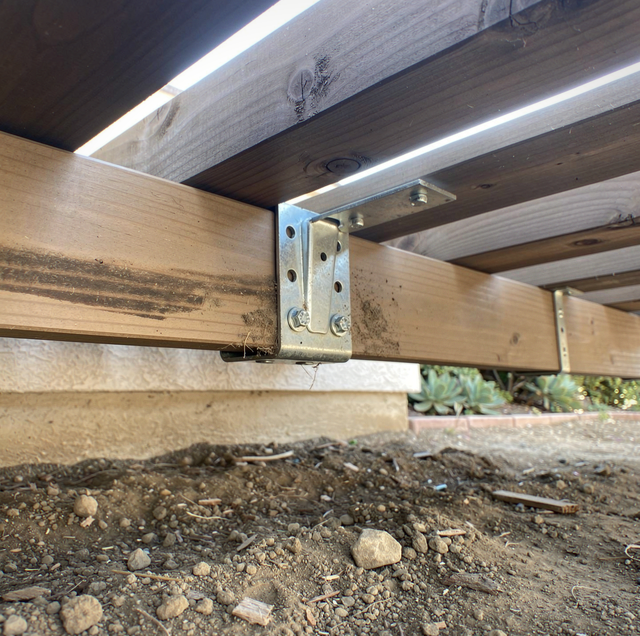
Wood members rarely fail in the middle. They fail at their ends and at their connections, because those are the places where water collects, where end grain drinks, and where metal meets lumber.
A joist hanger pocket holds a small reservoir every time it rains. A post base sitting flat on a concrete pad wicks up whatever runs down the post. A ledger board bolted against the house traps water behind it when the flashing above has failed.
Fasteners give way before framing does, and they usually give way quietly. A lag bolt in softened wood does not snap. The wood around it compresses, the connection loosens a fraction, and the member it holds begins to move slightly under load. By the time a deck feels different underfoot, its connections have been losing grip for several seasons.
Soft wood gives under slight pressure, holds moisture longer than sound wood, and stops gripping a fastener long before it looks rotten. The age of the movement matters as much as the amount. Flex creeping up over three years sits in a different category from flex that appeared after one wet winter.
Three Patterns of Movement and What Each Points To
Most reports of a bouncy deck fall into one of a few patterns, and the pattern narrows the search before anybody picks up a flashlight. The table below pairs what you feel with the part of the structure that pattern usually implicates.
| What you feel | Where it shows up | What the pattern usually implicates |
|---|---|---|
| Springiness between two joists | One board, or a short run of boards | Decking span, fastener grip, or a joist losing bearing at one end |
| A whole bay dropping and returning together | A section several feet across | A joist, the beam under it, or the connection between them |
| Side-to-side sway with a flat surface | The entire deck, felt most at the rail | Post connections, lateral bracing, or footing movement |
| Spongy stair treads | One tread, or several on the same flight | Stringer damage, usually at the cut notches or the bottom bearing point |
| A rail that shifts when grasped | Posts around the perimeter | Fastener failure at the rail post connection |
No row above is a diagnosis. Each one is a starting point that keeps a crew from opening the wrong part of the structure first, and every row carries exceptions that only a look at the framing will sort out.
A Railing That Moves Is a Different Problem
Railing movement earns its own heading because the consequence differs from everything above it. A springy board is uncomfortable. A railing that shifts when someone leans on it has stopped doing the one job it exists to do: keeping a person from going over the edge at height. Rail posts are typically bolted to the rim joist or to a joist end, and that connection carries an outward load no other part of the deck ever sees.
Movement at a rail post also works as a reasonable proxy for the condition of the frame behind it, because the rim joist holding that post is the member most exposed to weather on the whole deck. Wobble at the rail frequently accompanies wider trouble in the framing rather than standing alone as a single loose bolt.
A bouncing deck or a railing that shifts when grasped can give way without warning, so keep people off it and have a licensed contractor inspect the framing, footings, and connections.
Why Deflection Gets Worse and Not Better
Deck movement feeds itself. Every flex cycle works a fastener slightly looser in its hole, and a looser fastener allows a fraction more movement on the next cycle. The gap that opens at that connection then holds water where no gap existed before, and wet wood around a fastener softens faster than dry wood two inches away. What began as a connection carrying its full share ends up as a connection carrying most of that share, then some of it. Joists also lean on each other sideways. Blocking set between them spreads a load across several joists, and where it is missing or loose, each joist deflects alone.
Ground under the footings moves on its own schedule. Soils that swell when wet and shrink when dry lift and drop whatever sits on them, so a post whose footing has risen is carrying more of the deck than its neighbors while another post two bays over is carrying less. Redistribution like that shows up as flex in the bays that picked up the extra load, which is rarely the bay anyone would have guessed.
Repair or Replacement: How the Line Gets Drawn
The question every bouncy deck eventually raises has a fairly clean dividing line, and age is not what draws it. Major structural damage, rot running through multiple members, and safety concerns that change how the deck carries people push a project toward replacement. Loose boards, a tired finish, a handful of popped screws, and localized wear sit on the repair side of that line.
What moves a deck across that line is the count and location of the affected members. One joist softened at one end is a repair, because a single member can be sistered or swapped with the surrounding frame left in place. Six joists softened at the same end, on the same beam, along the same wall, describe a condition affecting the whole run, and replacing them one at a time leaves the cause in place.
Posts and footings change the arithmetic again. A surface and a frame sitting above sound footings can be rebuilt on what is already in the ground. Footings that have shifted, or post bases that have rotted where they meet the concrete, mean the rebuild starts at the ground instead of at the surface, and at that depth, keeping the old framing above makes little sense.
What the First Visit Rules Out
An inspection of a moving deck works by elimination, and the first visit is mostly about removing possibilities. Somebody walks the structure from underneath and around the perimeter, examining footings, posts, beams, joists, the ledger connection at the house, and the surface materials, roughly in that order, because a problem at the ground end changes the meaning of everything found above it.
By the end of that visit, several explanations have usually been ruled out. A surface that needs only refinishing is confirmed within minutes. One loose fastener gets ruled out when a second and a third connection show the same condition. A single-bay problem gets ruled out when probing finds soft wood at four joist ends along the same beam. What survives the elimination is a short list, and it is usually smaller than the homeowner feared, or larger, but seldom what they expected.
A permit may be required for structural deck work, and the contractor typically handles the paperwork as part of the project. Ask about it at that first visit, alongside the short list itself, because the schedule and the scope get built around whatever the elimination left standing.
Frequently Asked Questions
Some. Every framed floor deflects under load, and the deck you walk on sits outdoors on joists spanning several feet, so you will always feel some give. Normal bounce stays small, stays even across the surface, and stays about the same year to year. What deserves attention is bounce you notice growing, bounce you feel in one area while the rest of your deck stays firm, or bounce that no longer springs back the instant you step off.
Often. When the movement you feel traces to a few members or loosened connections, sistering a joist, replacing a hanger, or resetting a post can restore the stiffness you lost without touching the rest of your structure. That route closes when you find the same condition across many members, because fixing them one by one leaves the cause working on your deck.
Regularly. The surface you walk on dries fastest after rain, takes the most sun, and gets refinished more often than anything beneath it, so it is the last layer to show trouble. The framing below the boards you can see holds moisture at hangers, at joist ends, at the ledger, and at every fastener, mostly in shade. A deck with newer boards and a clean finish can sit on a frame that has lost capacity, and the movement you feel underfoot is your first clue that anything changed under you.
Stair stringers are cut from one piece of lumber, and notching them for each tread removes material from the member carrying you up the whole flight. Those cut faces expose end grain to water, and a stringer's bottom end usually sits close to soil or on a pad where water pools under your stairs. A tread that gives under your foot points at the stringer beneath you more often than at the board you are standing on.
A step change usually traces back to a connection that finished letting go, rather than to a new problem appearing. A fastener loosening for seasons finally stops holding, or a joist end softening crosses the point where it can no longer carry its share. Wet seasons speed both along beneath you. The timing you noticed is real, but what you felt marks the end of a slow process on your deck, not the beginning of one.
The dividing line follows damage, not age. Major structural damage, extensive rot, or safety concerns that change how your deck carries people push it toward replacement, while minor issues such as a few loose boards or a faded finish call for repair or resurfacing. Between those two, the questions that settle it are how many members are affected, whether they are affected at the same detail, and whether the structure under you is sound. One soft joist end on your deck is a repair. Six soft joist ends along one beam describe a condition, and a repair leaves that condition in place. Once your footings or post bases are involved, the rebuild starts at the ground, and keeping the old frame above it seldom works out in your favor.
Book a free in-home deck inspection — get a straight read on whether the bounce you feel underfoot is a repair at a few connections or a framing problem that runs the length of your deck, before another season of weather works the fasteners any looser. Clover Valley Home Service serves Greater Sacramento, Placer, and El Dorado counties. CSLB #1003154. Call (916) 742-3141.