
Foggy Windows Between the Panes: What the Haze Really Means
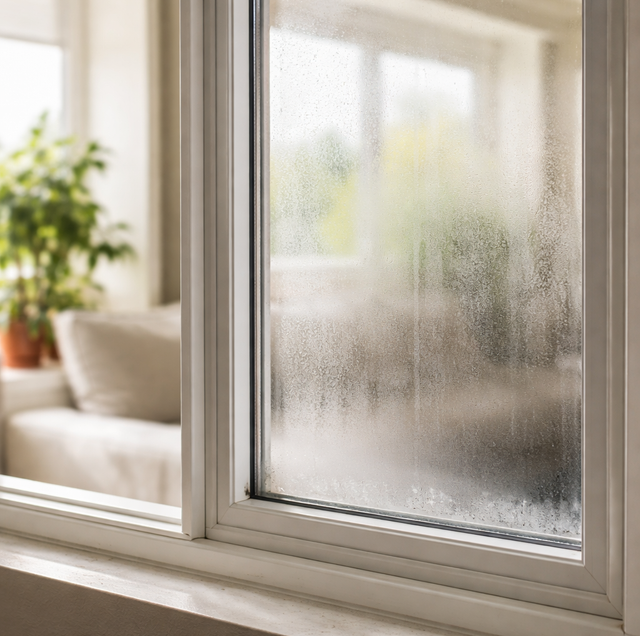
Quick Answer: Fog trapped between the panes of a double- or triple-pane window means the sealed glass unit has lost its seal and let moisture inside. It is an efficiency and appearance problem, not usually an emergency. The fix is replacing the glass unit or the whole window; some warranties still cover it.
You reach for a cloth, wipe the glass, and the haze stays put. Wiping the inside does nothing either. The fog is sitting somewhere you cannot get to: between the two panes of the window itself. That single detail tells you almost everything. When moisture shows up in that sealed gap, the window has stopped doing one of its main jobs, and no amount of cleaning will bring it back.
What Sits Between the Panes of a Modern Window
A modern insulated window is not one sheet of glass. It is an assembly the trade calls an insulated glass unit, or IGU. Two panes of glass (three in a triple-pane) are held a fixed distance apart by a metal or foam spacer that runs around the entire perimeter. The gap between them is filled with a dry, still layer of air or an inert gas such as argon or krypton, which slows heat transfer far better than open air would.
Two more parts make the assembly work. Inside the hollow spacer sits a desiccant, a moisture-absorbing material similar to the little silica packets that come in a shoebox. Its job is to soak up the tiny amount of humidity sealed in during manufacturing so the space stays clear. Around the outside edge, a primary and secondary sealant bonds the panes to the spacer and forms an airtight, watertight barrier. That perimeter seal is what keeps the gas in and the outside air, with all its moisture, out.
When everything holds, the space between the panes stays bone dry and invisible. You never think about it. The seal only announces itself by failing.
Why the Seal Eventually Lets Go
A window seal is a bonded joint asked to survive decades of stress, and several forces work against it at once.
Heat cycling: Sun warms the glass, and the trapped gas expands; night cools it and the gas contracts. That expansion and contraction pumps the sealant thousands of times a year. Sealants that face direct sun and wide daily temperature swings age faster than ones on a shaded side, which is why one window on a wall can fog while its neighbor stays clear.
Age and UV exposure: Organic sealants lose flexibility over time, and ultraviolet light slowly breaks down the materials it reaches. Most IGUs are built to last somewhere in the range of ten to twenty years, though real-world life depends heavily on quality and exposure.
Trapped water at the frame: If a window frame's weep holes clog or drainage channels back up, water pools against the bottom edge of the glass unit and sits on the seal. Constant moisture contact is one of the faster ways to break a seal down.
Manufacturing variation: A weak spot in the original sealant bead, a spacer corner that was not fully sealed, or a marginal desiccant fill can cut an IGU's life short. When a window fogs unusually early, a factory defect is a fair suspicion, and it is also where a warranty most often applies.
Once the seal breaks anywhere along its length, humid outdoor air seeps into the gap. The desiccant saturates, and after that it can no longer keep up. Moisture then condenses on the cool inner glass surfaces as fog, and over many cycles it can dry into a permanent cloudy mineral film that no cleaning reaches.
Telling the Three Kinds of Condensation Apart
Not all window condensation is a failed seal. Reading which surface the moisture is on tells you which problem you actually have, and they call for completely different responses.
On the inside surface (the room side): Water or fog you can wipe off with a cloth from indoors means humid room air is hitting cold glass. It signals high indoor humidity, not a broken window. It shows up most where air is moist and still: kitchens, bathrooms, bedrooms overnight, and near plants or aquariums.
On the outside surface (the exterior): Dew on the outer glass that you would have to go outside to wipe is harmless and usually a good sign. It happens when the outer pane cools below the outdoor dew point, common on clear, calm mornings. It means the outer glass is staying cool because the window is insulating well, and it clears on its own as the day warms.
Between the panes: Fog, droplets, or a haze you cannot reach from either side is the tell-tale sign of a failed IGU seal. You cannot wipe it, and it typically comes and goes with temperature and sun before eventually leaving a permanent film. If wiping both accessible surfaces leaves the cloudiness untouched, the seal is the answer.
What a Failed Seal Actually Costs You
A fogged unit looks alarming, but understanding what has and has not gone wrong helps you decide how fast to act.
The insulating gas fill has largely escaped, so the window no longer resists heat transfer as well as it did. You lose some efficiency, and the glass runs colder or hotter than its intact neighbors. The trapped moisture leaves haze and, over time, a mineral film that dulls the view and can look permanently dirty. On coated glass, long-term moisture can also degrade low-emissivity coatings.
What usually has not happened is anything structural or dangerous. The glass is intact, the window still keeps weather out, and a foggy pane is not an emergency you must fix this week. It is a comfort, efficiency, and appearance issue you can plan around.
The real caution lies at the frame, not the glass. If a clogged weep system lets water pool and break the seal, that same standing water may be rotting the sill or sash. Soft, spongy, or discolored wood around a foggy window is the part that deserves prompt attention, because rot spreads and gets expensive. The glass can wait; wet, decaying framing cannot.
Your Repair Options, and the Tradeoffs
Once a seal is gone, cleaning and drying agents will not restore it. There are three main paths.
Replace the IGU (the glass unit only). If the frame and sash are sound, a technician can replace just the sealed glass unit and reuse the existing frame. It is the most common fix and fully restores the window, including a fresh gas fill and desiccant. It hinges on being able to source a matching unit, which is easier on standard sizes than on unusual or older ones.
Replace the whole window. If the frame is rotted, the sash is failing, or the window is old enough that other parts are near the end of their life, replacing the entire unit can make more sense than patching one component. It is the choice when the framing itself is the problem.
Defogging service. Some companies drill small holes in the glass, flush and dry the cavity, and seal the holes to clear the haze. It can improve appearance, but it comes with real tradeoffs: it does not restore the inert gas fill, so the original insulating value does not fully return, and results vary, especially where a mineral film has already etched the glass. Think of it the way a mechanic thinks about a tire plug versus a new tire: it can buy time and looks, but it is not the same as replacing the failed part.
Warranty: Check Before You Pay
Many IGUs carry a manufacturer's limited warranty specifically against seal failure, often running a decade or two from the manufacture date, sometimes longer on higher-end lines. That coverage is easy to forget and easy to leave on the table.
Before paying for any repair, look for the manufacturer name and a date stamp, usually etched into the metal spacer at the edge of the glass or printed on a label in the frame. Many sealed units carry a limited warranty against seal failure for a decade or two, so confirming coverage first can change the whole plan.
Preventing the Next Failed Seal
You cannot make a seal last forever, but you can avoid the accelerators.
Keep weep holes and drainage clear: The small slots along the bottom of the exterior frame let rainwater drain instead of pooling against the glass edge. Clearing them of dirt and debris a couple of times a year keeps standing water off the seal, and it protects the frame from rot at the same time.
Manage indoor humidity year-round: This one prevents the interior-surface condensation that gets confused with seal failure, and it protects your framing in every season. Run bath and kitchen exhaust fans, use a range hood while cooking, and crack a window when moisture builds. In humid, warm conditions, a dehumidifier or air conditioning pulls moisture down; in cold, dry conditions, humid indoor air condensing on cold glass is the bigger risk, so easing back on humidifiers helps. The target sits in a moderate middle band rather than one extreme.
Ventilate stagnant, moist rooms. Still air holds moisture against cold surfaces. Moving air, an open interior door, a running fan, or a cracked window keeps humidity from settling on the glass and on the sills below.
Persistent interior condensation is worth chasing down, not ignoring. Left alone, that moisture can feed mold and rot around sills and frames, so treating the humidity source protects the house, not just the view.
Inspecting or replacing glass on upper-floor windows is a real fall risk. Leave that work to someone set up to do it safely rather than reaching from a ladder.
Frequently Asked Questions
Consumer defog kits exist, and they follow the drill-flush-dry-plug method, but the honest ceiling is low. They can reduce visible haze, yet they cannot re-inject argon or replace a saturated desiccant, so the insulating value stays diminished. Where a mineral film has already etched into the inner glass, no flush will lift it. For a window still under warranty, drilling the glass yourself typically voids that coverage, which can cost far more than the kit saves.
No. In most cases, only the sealed glass unit is replaced while the existing frame, sash, and hardware stay in place. Full-window replacement is reserved for cases where the frame is rotted, the operating hardware is worn out, or a matching glass unit cannot be sourced for an odd or discontinued size. The sash is the moving frame that holds the glass; if it is sound, it usually stays.
Before the desiccant fully saturates, a failing seal behaves like a barometer. On warm, sunny afternoons the trapped moisture evaporates, and the glass looks clear; on cool mornings it condenses back into visible fog. That coming-and-going is actually a useful early warning that a seal is compromised, often showing up before permanent filming sets in. Once the internal film becomes permanent, the cloudiness stops fluctuating and simply stays.
Not through the glass itself. The moisture in a failed IGU is a tiny amount sealed in the cavity, not a path for rain to enter the room. The leak risk lives at the frame instead: if blocked weep holes let water pool, that water can find its way past worn frame seals or into the wall below. That is why clearing weep holes matters as much for keeping water out as for protecting the glass seal.
Most of the loss comes from the escaped inert gas rather than from the moisture. Argon and similar fills conduct heat noticeably less than plain air, so once they leak out, the unit performs closer to a basic double-pane with an air gap. You often notice it as glass that feels colder or hotter to the touch than an intact window beside it, and as more heat flow at that spot. It is a measurable dip, not a total loss of insulation.
No. A triple-pane unit has two sealed gaps and two spacer runs, so it actually has more sealed length that can eventually fail, sometimes in one cavity while the other stays clear. The upside is that the extra pane and second gas fill give it a larger efficiency cushion, so a single failed cavity may be less noticeable than the same failure in a double-pane. The seal science and the repair path are the same.
Book a window and moisture inspection before a foggy pane hides frame rot behind it — get a clear diagnosis and a repair plan that fits. Clover Valley Home Service serves Rocklin, Roseville, and Granite Bay. CSLB #1003154. Call (916) 742-3141.
