
How Thermal Imaging Finds Hidden Leaks Without Opening Walls
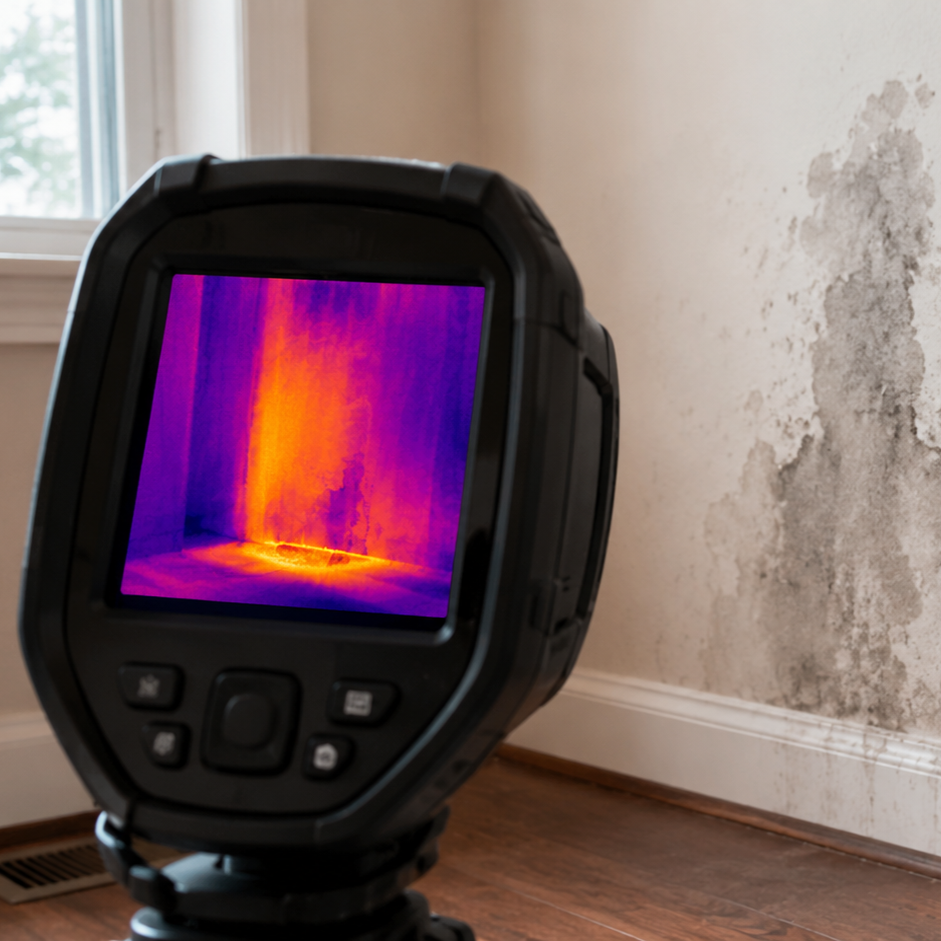
Quick Answer: Thermal imaging finds hidden leaks by reading surface temperature, not by seeing water directly. A leak makes the surrounding material wet, and wet material holds and conducts temperature differently than dry material, so it shows up as a distinct cool (or sometimes warm) area on the camera. A technician scans walls, ceilings, and floors, spots the temperature anomaly, then confirms it with a moisture meter. The big advantage is that it locates moisture without cutting into the wall, so demolition is targeted to the actual problem area instead of guesswork. It's a detection tool, used alongside other methods, not a magic x-ray.
Finding a leak inside a wall used to mean cutting holes and hoping you guessed right. Thermal imaging changed that. By reading the heat signature of a surface, a technician can locate hidden moisture without opening the wall at all — and that means repairs go straight to the problem instead of leaving a trail of exploratory holes.
What Thermal Imaging Actually Sees
A thermal camera doesn't see water, and it doesn't see through walls. What it sees is surface temperature. Every surface emits infrared energy based on its temperature, and the camera converts that radiation into a visible image, with different colors representing different temperatures.
That distinction matters: the camera reads the temperature of the wall surface, and from that, a trained eye infers what's happening just behind it. Moisture is what makes the inference possible, because wet materials behave differently from dry ones.
Why Wet Spots Show Up
When water soaks into drywall, wood, or insulation, it changes how that material handles temperature in two ways. Wet material holds more thermal mass, so it heats and cools more slowly than the dry material around it. And evaporating moisture cools a surface. The result is that a damp area usually appears as a cooler patch standing out against the drier, surrounding surface — an anomaly with a shape that often traces the path of the water.
A technician looks for these patterns: a cool plume spreading down from a window, a cool ring on a ceiling, a cool band along a baseboard. The pattern itself hints at the source — water spreading from above looks different from moisture wicking up from below.
The Step That Confirms It
Because the camera reads temperature and not moisture directly, a temperature anomaly is a lead, not a verdict. Plenty of things cause cool spots that aren't leaks — a stud behind the drywall, a draft, missing insulation, or a cold pipe. That's why thermal imaging is paired with a moisture meter. The technician scans broadly with the camera to find suspect areas fast, then touches a moisture meter to those spots to confirm whether they're actually wet. The camera finds it; the meter proves it. This pairing also speeds up a larger job. Instead of inspecting a whole house inch by inch with a meter, the technician sweeps each room quickly with the camera to find the handful of areas worth a closer look, then spends the slower meter time only where it counts. The camera is the wide net; the meter is the close inspection. Used together, they cover more ground and miss less than either tool could on its own.
| Strength of thermal imaging | Limitation to know |
|---|---|
| Scans large areas quickly | Reads surface temperature, not water |
| No cutting or demolition to look | Anomalies need meter confirmation |
| Reveals the spread pattern of moisture | Can't see through walls |
| Finds moisture behind intact finishes | Conditions affect what shows up |
| Targets repairs to the real spot | Not a standalone diagnosis |
Why It Saves Demolition
The practical payoff is less destruction. Without thermal imaging, finding a hidden leak often meant opening multiple sections of wall to chase the water. With it, a technician narrows the wet area to a specific spot before any cutting happens, so the opening is made exactly where the problem is. That means a smaller repair, less mess, and less guesswork. For a homeowner, it's the difference between one targeted patch and a wall full of investigative holes.
Thermal scans work best when there's a temperature difference to read. A technician may run the heat or AC, or schedule the scan for a time of day when the wall and the moisture behind it differ enough in temperature to make the wet area stand out clearly.
What Affects the Results
Thermal imaging isn't foolproof, and conditions influence what it can reveal. A leak that's fully dried may not show up because there's no moisture left to create a temperature difference. Very small differences can be hard to read, and surfaces like tile or glossy paint reflect infrared in ways that complicate the image. A skilled operator accounts for these factors, which is why interpretation matters as much as the equipment. Reflective and textured surfaces can throw off a reading, too, so the operator often changes the viewing angle or shades a window's glare to get a clean image. None of this makes the tool unreliable; it just means the person behind the camera matters, and experience is what turns a colorful picture into an accurate call about where the water actually is. In the right hands, it's a powerful first pass that focuses everything that follows.
Frequently Asked Questions
No. A thermal camera reads the temperature of the surface it's pointed at, not what's behind it, and it doesn't detect water directly. It indirectly reveals hidden moisture because wet material changes the surface temperature in a way the camera can detect. The image points to where moisture likely is, and a moisture meter confirms it.
Two reasons: wet material holds temperature and changes more slowly than dry material, and evaporating moisture cools the surface. Together, these usually make a damp area appear as a cooler patch against the drier surroundings. The cool spot's shape often traces how the water has spread, which helps point to the source.
It's accurate as a detection tool when used correctly and confirmed with a moisture meter. The camera quickly flags suspect areas over a large surface, and the meter verifies whether they're actually wet. On its own, it can be misread, since not every temperature difference is moisture, so the two methods together are what make it reliable.
Often not. If an area has fully dried, there's no moisture left to create the temperature difference the camera relies on, so it may not appear. Thermal imaging is best at finding active or recent moisture. For a leak that comes and goes, scanning while it's active gives the clearest result.
It locates the moisture before any cutting, so the wall is opened only where the problem actually is. That avoids the common alternative of making several exploratory holes to chase a leak. The result is a smaller, targeted repair with less mess and less guesswork, which is easier and cleaner for the homeowner.
Usually, some access is needed to fix the leak and dry the cavity, but the scan means it's a precise opening rather than exploratory demolition. The camera and moisture meter narrow the work to the right spot, so the repair is focused. The goal is to cut once, in the right place, instead of several times while searching.
Find It First, Cut Once
Thermal imaging works by reading temperature, using the way wet materials behave to reveal moisture hiding behind an intact wall. Confirmed with a moisture meter, it turns leak detection from guesswork into a targeted process — finding the problem before anyone picks up a saw. The payoff is a smaller, smarter repair that goes straight to the source.
Want a hidden leak found without tearing up your walls? — Get a thermal and moisture inspection that pinpoints the problem before any cutting. Clover Valley Home Service serves Greater Sacramento, Placer, and El Dorado counties. CSLB #1003154. Call (916) 742-3141.
