
Why Tile Grout Cracks: What Your Floor Is Really Saying
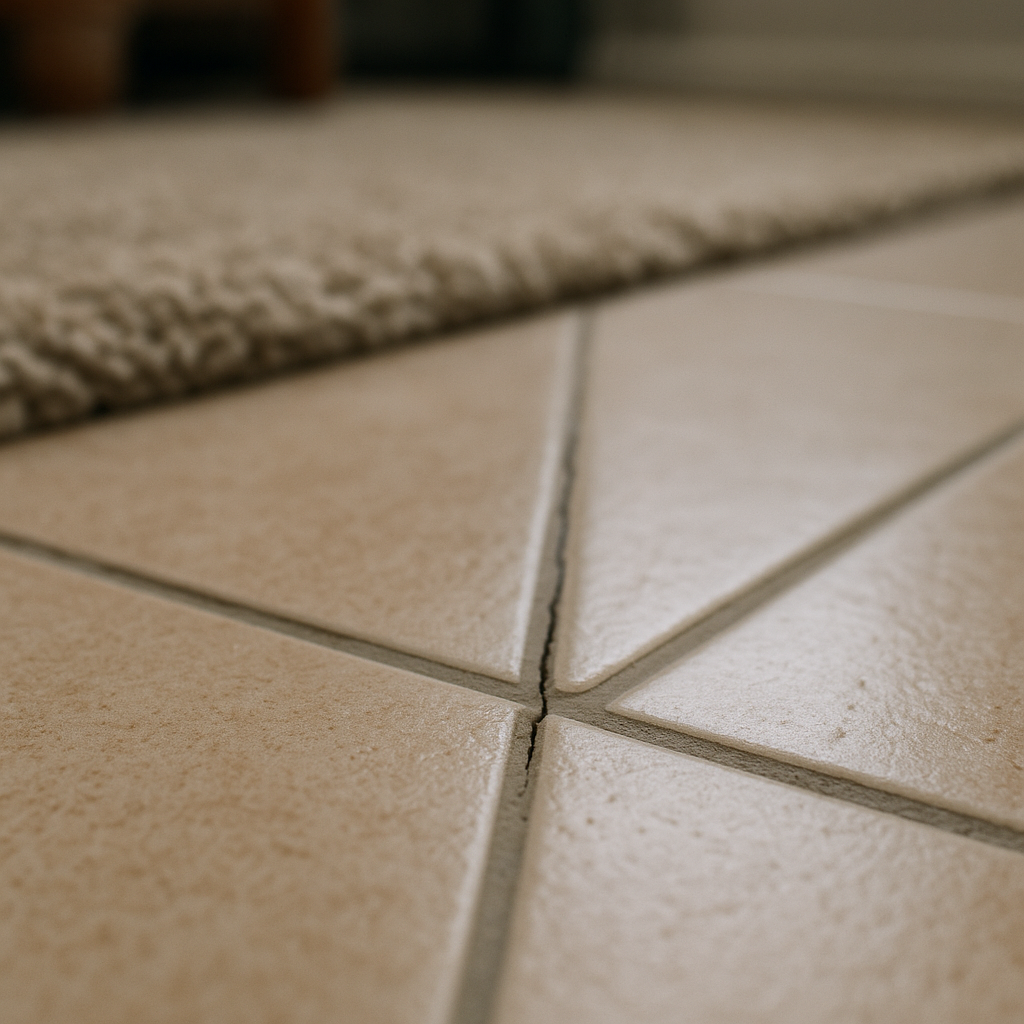
Quick Answer: A hairline splits the grout line between two tiles, you fill it, and a few months later, it opens again in the same place. Most people treat that as a grout problem and reach for a fresh tube. The grout is not the problem. It is the messenger.
Grout is rigid. Once it cures, it does not flex, and it was never meant to. So when a grout line cracks, something under the tile moved, and the grout, having nowhere to give, splits to relieve the stress. The crack is a symptom. The cause almost always lives below the tile, in the subfloor or the substrate the tile was set over. Reading the crack correctly is the difference between a repair that lasts and one that fails on the same line by next season.
What Actually Cracks the Grout
Picture the tile floor as a stack of layers. On top are the tiles and grout, hard and unforgiving. Beneath them is a bed of thinset, then a substrate, then the subfloor, then the joists carrying the whole thing. For that hard top layer to stay intact, everything below it has to hold still. Tile and grout tolerate almost no movement. When the layers underneath shift, deflect, or swell, the movement travels up and comes out at the weakest point, which is the grout joint.
Think of grout like the plaster skim on a wall. As long as the wall behind it is solid, the plaster stays smooth. Let the wall shift even slightly, and the plaster cracks in a line, not because the plaster failed, but because it was asked to bridge a gap it was never built to bridge. Grout behaves the same way on a moving floor.
The Subfloor Causes Behind Most Cracks
A flexing subfloor is the most common culprit. If the floor joists are spaced too far apart, are undersized for the span, or the subfloor panel over them is too thin or has softened, the floor deflects underfoot. You may feel it as a faint bounce when you walk across the room. Tile cannot ride that bounce. Every step flexes the assembly a fraction, and over weeks, that repeated micro-movement works the grout loose and opens a line.
Setting tile over the wrong substrate is the next big cause. Tile bonded directly to plywood or another wood-based panel is set on a material that expands and contracts as it takes on and releases moisture with the seasons. Wood moves; tile does not. That mismatch alone can telegraph cracks into the grout even on a floor that feels solid, which is why a proper cement backer board or an uncoupling layer belongs between the tile and a wood subfloor.
Missing movement joints cause cracks in wide tile fields. A large run of tile expands and contracts as a unit, and where that whole field meets a wall, a doorway, or a change in the floor plane, it needs a soft joint to absorb the movement. When the installer grouts those transitions solid instead of leaving a flexible joint, the field has nowhere to expand, and the grout cracks along the line of greatest stress.
A cracked slab underneath can also show up top-side. When tile is set over a concrete slab that later cracks, or was already cracked, the movement in the slab can telegraph straight up through the thinset and split the grout in a line that mirrors the crack below.
When the Grout Itself Is at Fault
Not every crack points to the structure. Sometimes the grout was the wrong choice or was mixed badly. Grout that was mixed too wet, retempered with extra water after it started to stiffen, or troweled into joints that were too deep can shrink and crack as it cures, and that shows up early, usually within the first weeks. House settling adds another layer: a new home or an addition can shift as it settles onto its foundation, and that one-time movement can crack grout during the first year even when the floor build was sound.
The way to tell these apart is to read the pattern. A single hairline in one spot, with no bounce in the floor and no spread, is usually minor. It can come from a small shrinkage issue or a one-time settling event, and once the movement stops, it stays put after a repair. A crack that runs in a repeating line, follows a joist, tracks straight across a room, or returns in the same place after you fill it, is reporting movement. That one is telling you the floor beneath is still working, and no amount of fresh grout will hold until the movement is addressed.
Why It Matters Beyond the Cosmetics
It is tempting to see cracked grout as a purely visual annoyance. The risk is that a moving floor rarely stops at the grout. The same flex that opens a grout line will, given time, crack the tiles themselves and break the bond between tile and thinset. Once that bond lets go, the tile flexes freely and often sounds hollow when tapped, and hollow tiles work loose. So recurring grout cracks are an early warning. Caught at the grout stage, the underlying issue can often be corrected before it climbs into cracked and loose tile, which is a far larger repair.
What Actually Holds
A floor that keeps its grout intact starts with stiffness. The subfloor has to be rigid enough that tile does not feel any bounce, which means joists and subfloor panels sized for the span so deflection stays within the limits tile can tolerate. Adding an extra layer of subfloor to a bouncy floor, or sistering weak joists, is often where a lasting fix begins.
Above that stiffness comes the right separation layer. Cement backer board provides tile with a stable, dimensionally stable base rather than bonding it to moving wood. An uncoupling membrane goes a step further by allowing the tile and the subfloor to move independently, so seasonal expansion and minor deflection are absorbed by the membrane rather than transferred to the grout.
Then the movement joints have to be honored. Perimeters where the floor meets walls, doorway transitions, and long runs of tile need soft, flexible joints, usually a color-matched caulk, rather than rigid grout, so the field can expand and contract without tearing itself. And the grout itself has to match the joint: the correct type for the joint width, mixed to the right consistency, and not over-watered. Get the structure, the separation, the joints, and the grout right together, and the floor stays quiet.
Frequently Asked Questions
Not always, but recurring cracks point to a floor that flexes too much. The tile industry uses a deflection standard of L/360, meaning the floor should not flex more than its span divided by 360, and natural stone requires a stiffer L/720. A floor that visibly bounces when you walk across it is exceeding what tile tolerates. A one-time hairline from curing shrinkage or a single settling event is different and usually stays put once filled.
It is a thin, dimpled polyethylene sheet, roughly an eighth of an inch thick, set between the subfloor and the tile. Many versions are also waterproof and isolate cracks, so a crack in the slab below does not telegraph up into the tile. The dimples allow the tile and the subfloor to shift independently, accommodating small movement within the sheet rather than passing it into the joints. That is why it is often the go-to layer over a wood subfloor or a slab that already has hairlines.
Those perimeters and doorways are movement joints, and they get a color-matched silicone or siliconized caulk rather than rigid grout. Installers also leave a small gap, about an eighth of an inch, along the perimeter under the baseboard so the floor can expand without pushing against the walls. The caulk stretches and compresses as the walls and floor shift at different rates, where grout in that seam would simply crack.
Not as a real fix. Epoxy grout flexes slightly more than cement grout and resists re-cracking better as an interim measure, so it can buy time. But even epoxy will not hold if the subfloor movement underneath is not corrected first. The flex has to be stiffened out before rebuilding the joint, or the fresh material splits along the same line within a few months.
Sanded grout contains fine aggregate and is meant for wider joints, where the sand gives it body and helps it resist shrinkage as it cures. Unsanded grout is smoother and made for narrow joints. Using the wrong one for the joint width matters: unsanded grout packed into a wide joint can shrink and crack as it dries, so matching the grout to the joint is part of preventing cracks in the first place.
They can be, but location tells you a lot. A few hollow-sounding tiles at the very edge of a room can be normal, since that is the edge of the thinset bed. Hollow tiles in a walking path are a concern, especially when paired with cracked grout, because that combination signals a real bond failure. Those tiles usually have to be pulled and reset rather than patched over.
Book a flooring inspection — pinpoint what's moving under your tile before it turns into cracked and loose tiles. Clover Valley Home Service serves Greater Sacramento, Placer, and El Dorado counties. CSLB #1003154. Call (916) 742-3141.
